
In 2023, a young graduate named David Agbaje was unemployed and frustrated, staring at a Mathematics Education degree that wasn't opening any doors. "Numbers weren't adding up," he says of his job search, a sentence heavy with irony for a man trained in numbers. Then fate, in the form of a flyer handed to him on a Lagos street, changed everything. Today, David is Senior Sous Chef at Slow Lagos Restaurant, running a kitchen with the same discipline he once reserved for equations.

David's story isn't an outlier. It's a pattern. And WAVE's newly released 2025 Impact Report puts hard numbers behind it, numbers that matter to anyone thinking seriously about youth unemployment in Nigeria and what actually works to fix it.
Here are five lessons from the data.
Nigeria currently has nearly 13 million young people out of work, and the report is blunt about why: a broken bridge between education and employment that systematically sidelines youth from marginalised communities. WAVE's founding thesis, and 2025's strongest validation of it, is that this is an access problem, not an ability problem.
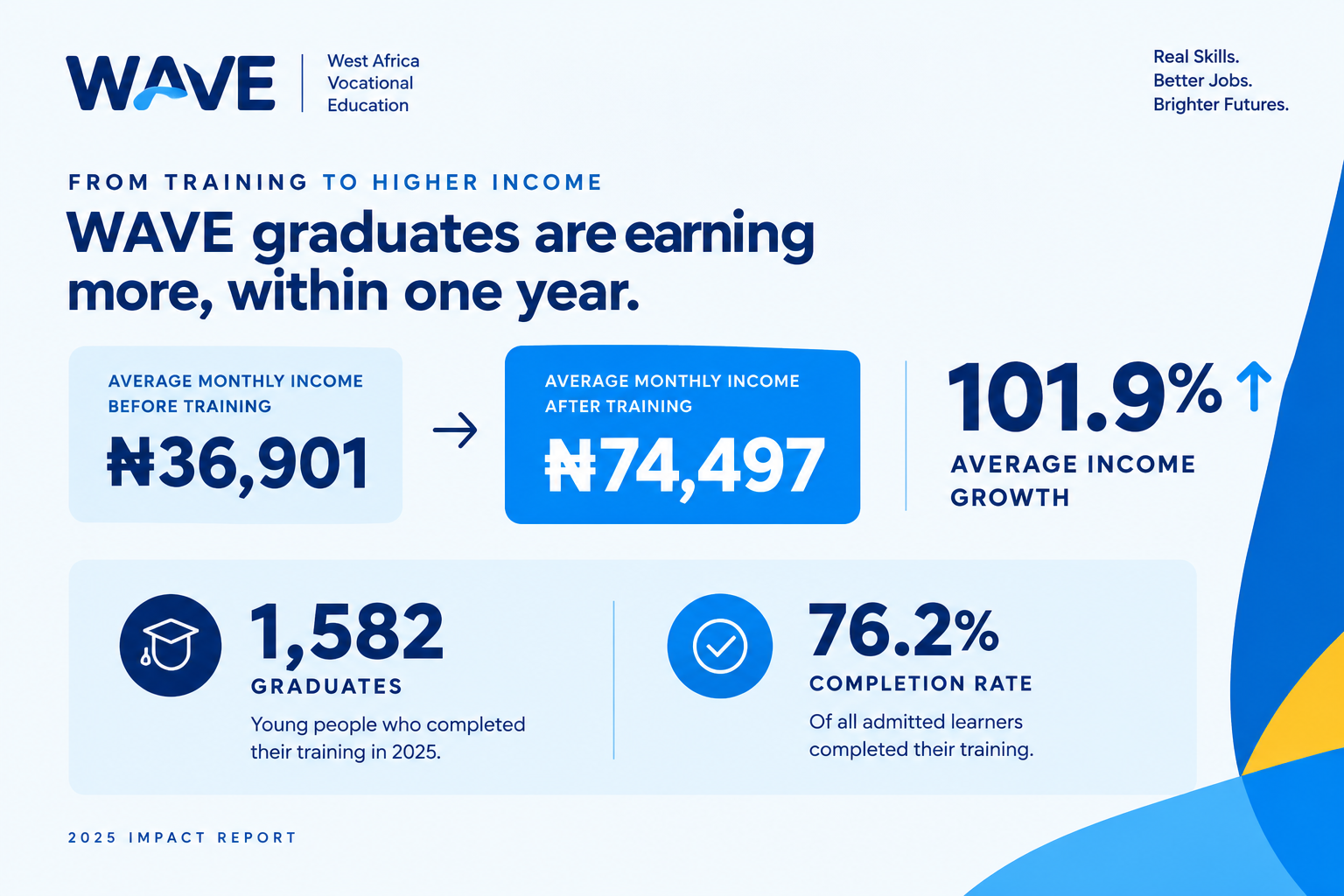
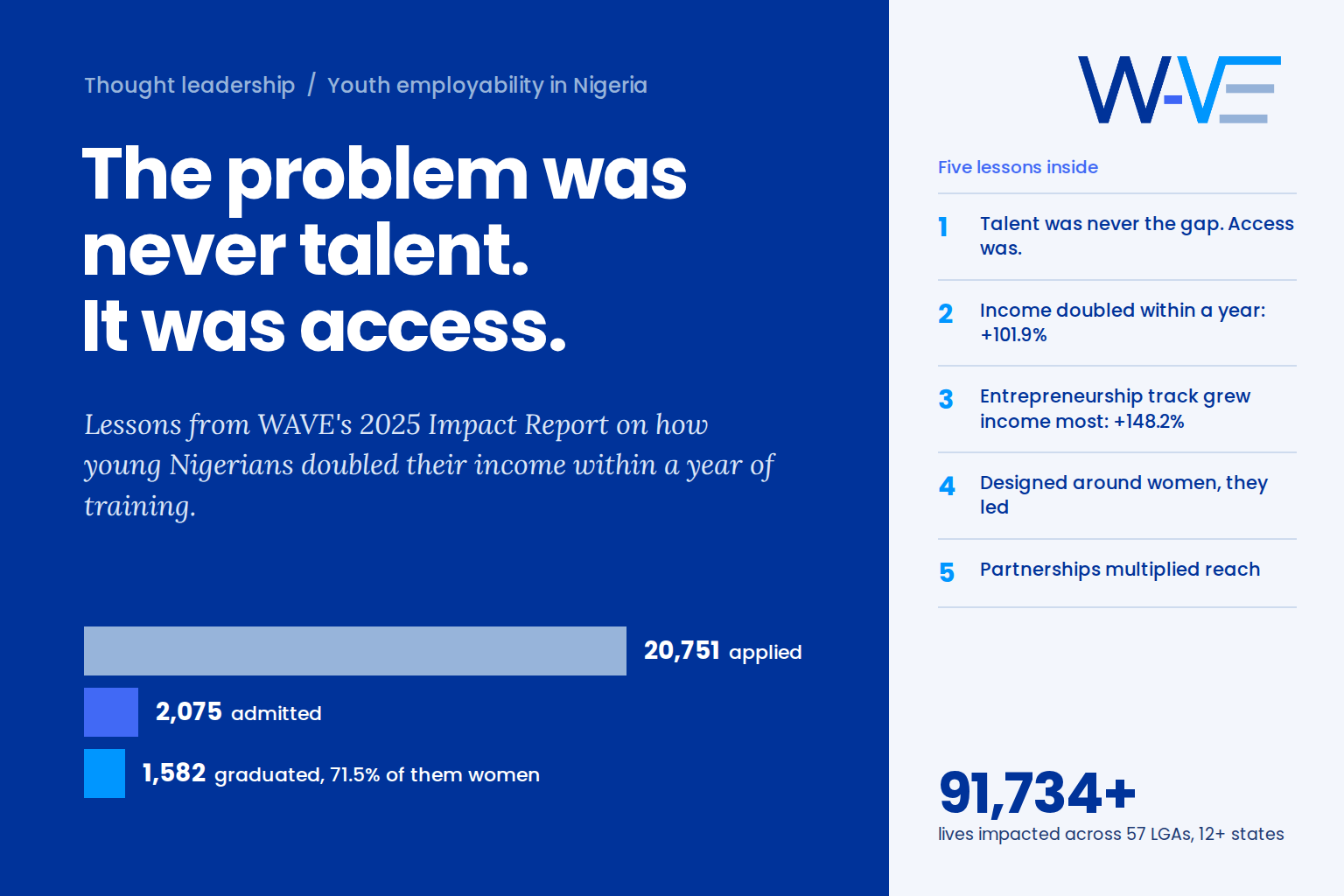
The evidence: WAVE received 20,751 applications in 2025 but admitted only 2,075 through rigorous selection, screening for hunger to learn and determination rather than credentials. Of those admitted, 1,582 completed training, a 76.2% completion rate that speaks to how much untapped capability was sitting untrained, one flyer or Instagram post away from a different trajectory.
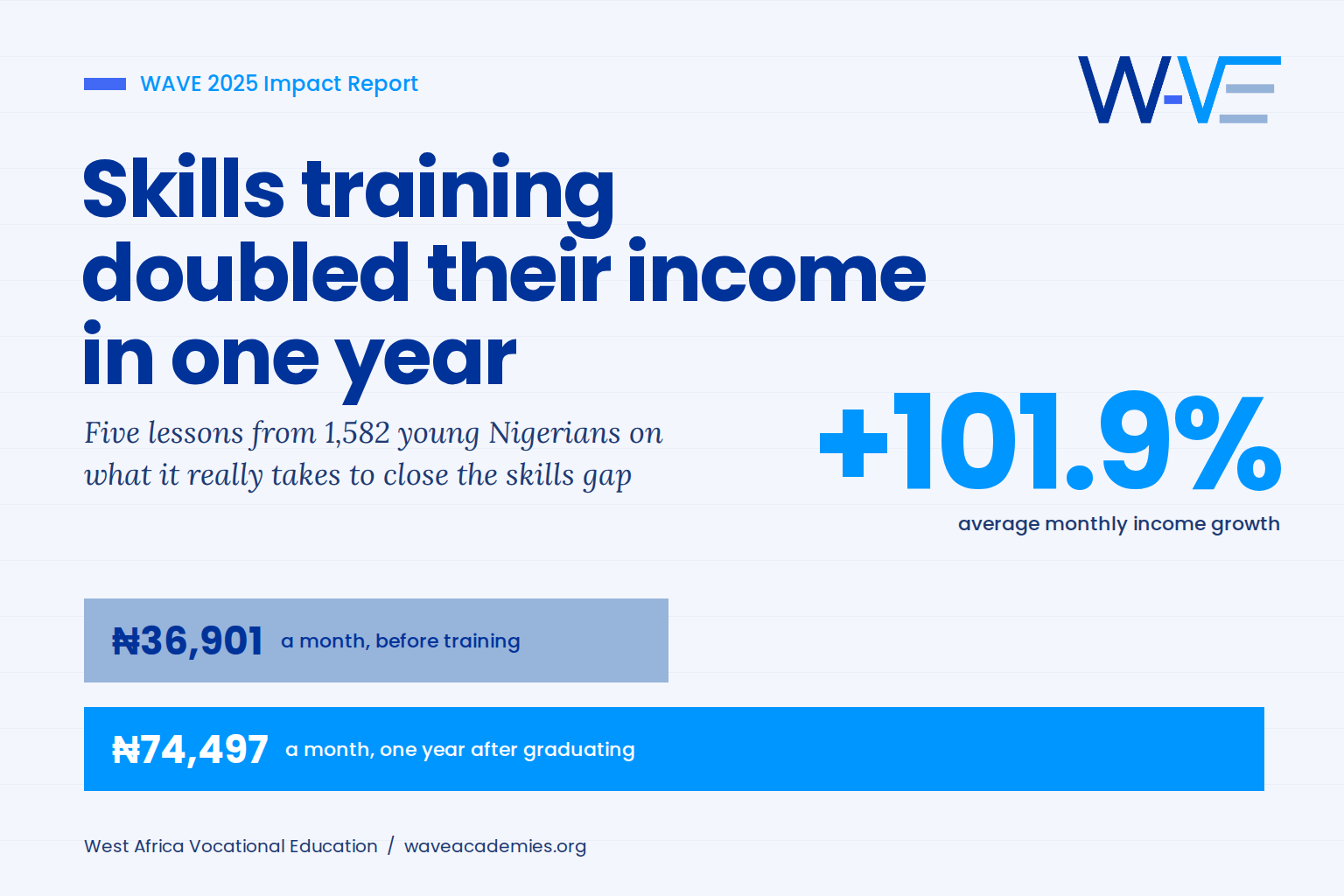
This is the headline number, and it's worth sitting with: the average WAVE graduate's income increased by 101.9% within one year of training, from ₦36,901 to ₦74,497 a month. Some individual outcomes went far beyond average. Godwin Ashibi, who started as a pharmacy sales associate through a WAVE placement, now holds two leadership roles simultaneously and has seen his income grow by as much as 1,233%.
This isn't a slow-burn development outcome measured in decades. It's immediate, measurable economic mobility, which is precisely the return on investment that should matter most to employers, government partners, and donors alike.
A quieter but important insight buried in the academy-by-academy breakdown: WAVE's entrepreneurship-focused academy (AiB5) posted the highest income growth of all four academies at 148.2%, ahead of formal employment-track training at 92.8%. For young people who want to build something of their own rather than wait to be hired, the report suggests business ownership may be a faster route to financial independence, a nuance worth more attention in Nigeria's broader youth employability conversation.
Women made up 71.5% of all 2025 graduates, roughly 2.5 women for every man. That's not incidental; it reflects intentional design choices: flexible scheduling for mothers, partnerships like the Lagos State Ministry of Women Affairs and Poverty Alleviation (WAPA), and job matches that respect family realities.
The results back the approach. AiB3, WAVE's most female-heavy cohort at 87.7% women, posted the second-highest income growth of any academy (139.7%). Mercy Odianosen, who left a teaching job to enroll, describing it as "a leap of faith," is now a confident front-desk professional at a fintech company. The lesson for the wider sector: gender inclusion isn't a compliance box. Done right, it's a growth strategy.
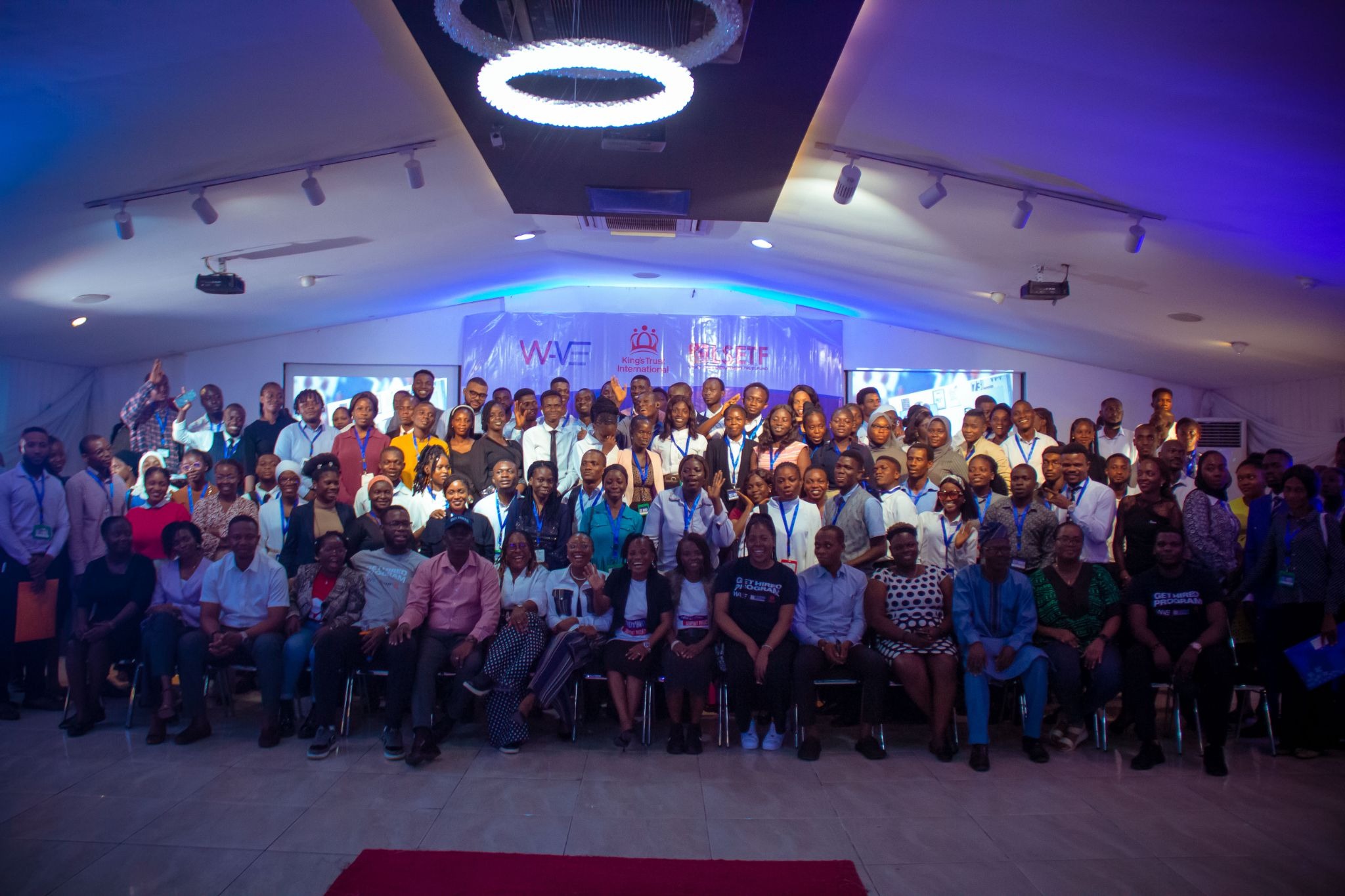
WAVE trained 1,582 young people directly in 2025, with the number strengthened through partnerships such as the Get Hired Project, delivered in collaboration with the Lagos State Employment Trust Fund (LSETF) and King’s Trust International (KTI). The project used a clear employment-focused strategy: young people were equipped with relevant industry skills and supported with the aim of transitioning into employment by the end of the programme. Beyond direct training, WAVE’s network of 36+ strategic growth partners, up 620% from just 5 partners in 2024, extended its reach to 80,734 additional young people, bringing total lives impacted to over 91,734. Geographic reach grew in step, expanding from 34 local government areas in 2023 to 57 across 12+ states in 2025.
This is arguably the most important structural lesson in the whole report: WAVE isn't just scaling a program. It's scaling a replicable model, one other organisations and state governments can adopt, which multiplies impact far faster than any single organisation training youth one cohort at a time ever could.
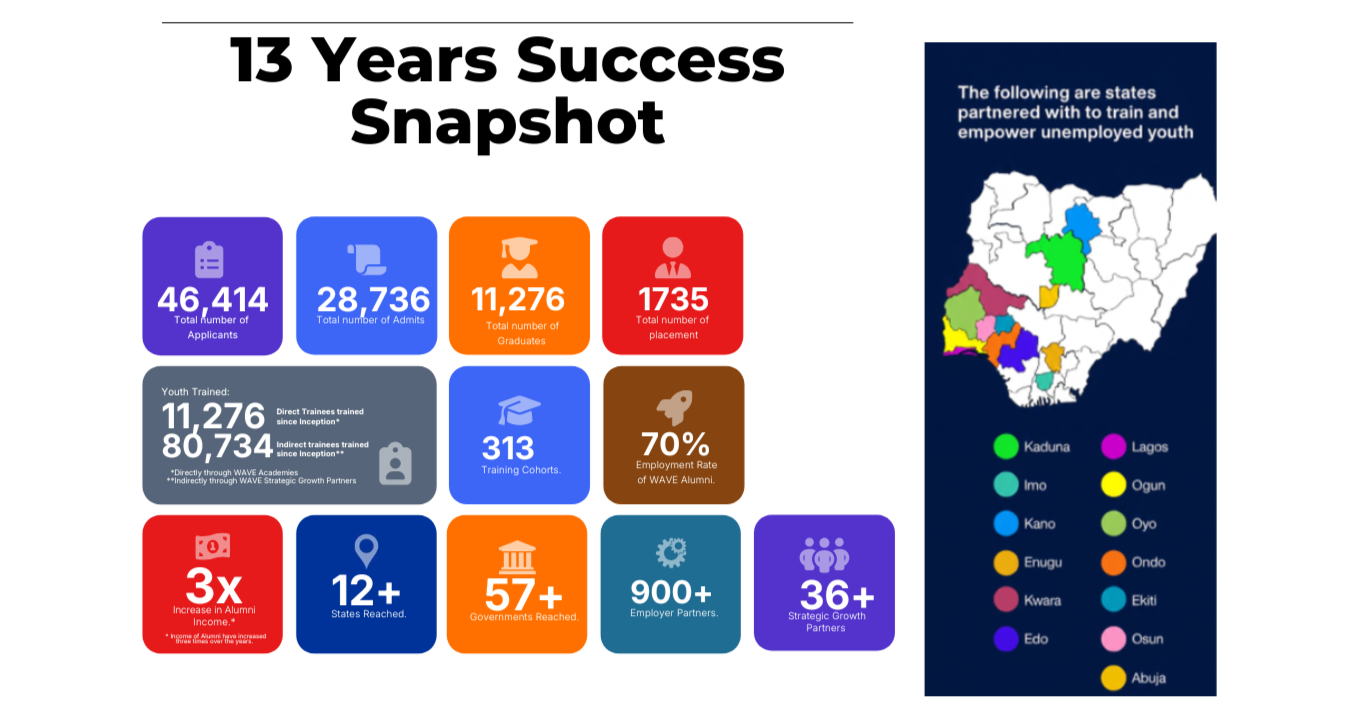
WAVE has set its sights on empowering 250,000 youth by 2028, a target that, on the back of 2025's evidence, looks less like ambition and more like a natural extrapolation of a model that's already working. As CEO Ifeanyi Perry writes in the report, the results confirm that "our model is scalable, our mission is urgent, and our vision is within reach."
For Nigeria's, and Africa's, broader youth unemployment crisis, that combination of urgency and evidence is rare. Most conversations about the skills gap stay theoretical. WAVE's 2025 numbers make the case that a proven, scalable answer already exists.
Read the full WAVE 2025 Impact Report, or explore how your organisation can partner with WAVE's growth network to bring this model to more young people.
© Copyright 2024 WAVE
All rights reserved.
Privacy Policy

